Testimonies of Violence and the Visualization of the Subjective
Over the past year, we have all witnessed the violence of the Serbian authorities. Given its nature, it is no surprise that the protests and organizing efforts of students, high schoolers, professors, teachers, and citizens triggered violent reactions from the Vučić regime. What is happening can serve as an illustration (proof, visualization, or example) of the “balance of power relations” thesis as defined by Foucault. He argued that when resistance becomes visible or effective enough to threaten the existing order, the power in place must react with force to re-establish a balance that suits its interests. That reaction is always—as it was this time—violent; however, we are not forced to believe that balance has been achieved, or that it is even possible for the regime ruling Serbia. The context is broader, and balance cannot be sought within a single part of the system, especially not at a time when its structure is overdetermined by war. Furthermore, some of those who experienced or suffered violence have decided to organize around the issue.
Beyond protests and mutual support, people have chosen to approach their experience systematically. They have organized actions to form registries and create tools for recording and collecting individual cases of violence, taking the truth into its own hands, and resulting in a situation where today, no one believes Vučić’s propaganda anymore. It now serves only to embolden the anxious and line up the disobedient participants within the government and in power.
Some examples of gathering facts on our side and transferring the truth to “free territory” include the “Crisis School Traffic Light” (Krizni školski semafor[1]) as a tool for systematically monitoring violations of rights and freedoms in high schools; the “Register of Legal Violence and Abuse of Institutions” (Registar pravnog nasilja i zloupotrebe institucija[2]) as a response to the systematic pressures faced by students, professors, and other members of the academic community; and the “For the Day After” Violence Database (Baza nasilja “Za dan posle”[3]). There are also initiatives for gathering facts about the perpetrators—the anonymous thugs participating in attacks on citizens during protests—but these are currently scattered across social media, where they invoke the need for transitional justice.
For this occasion, we are highlighting two initiatives; not only do they capture the attention of the public, but they also call for an ethico-aesthetic reappraisal of both politics and art. Furthermore, they confront us with questions regarding the politics of civil society, politics on the side of the people, and the nature of witnessing within political and legal processes. They also raise questions about artistic practice in a time and under circumstances where art may be losing its world.
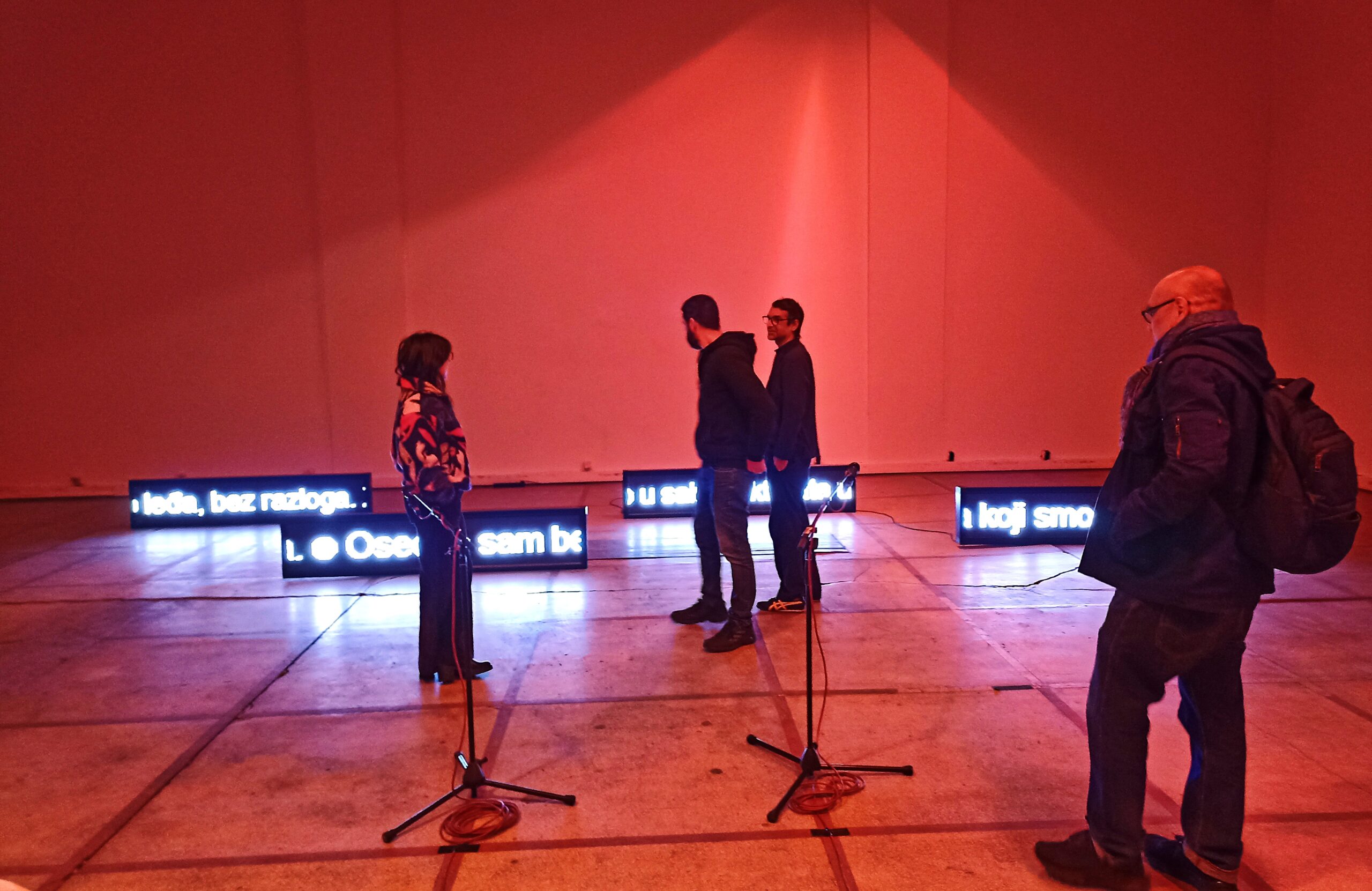
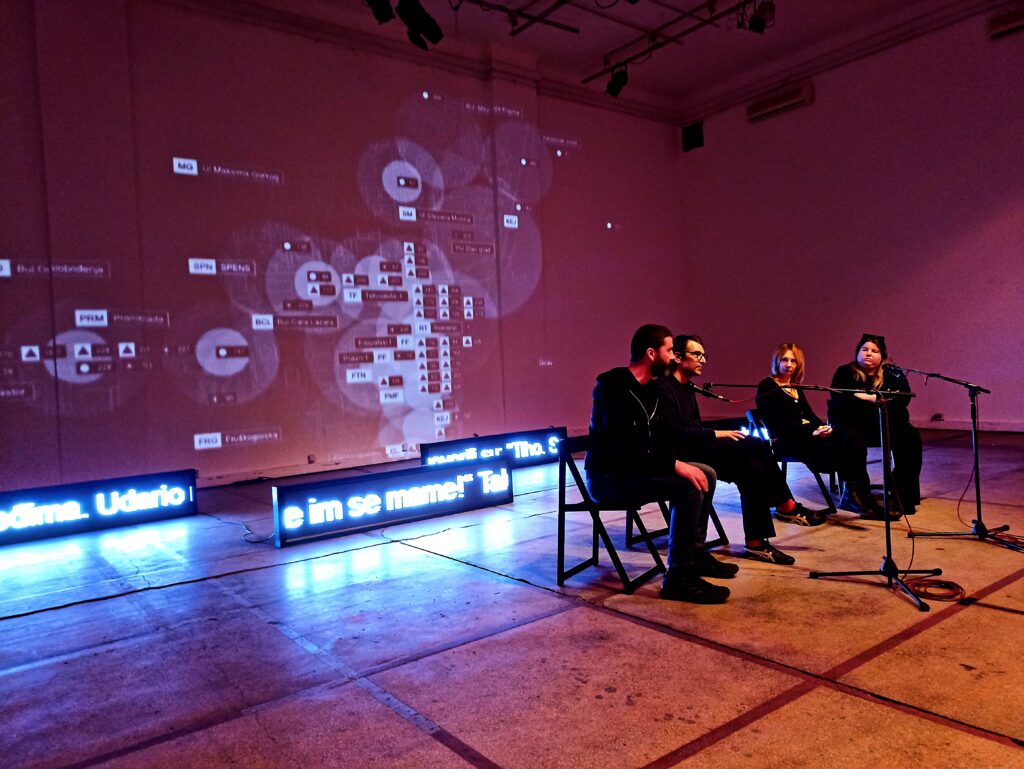
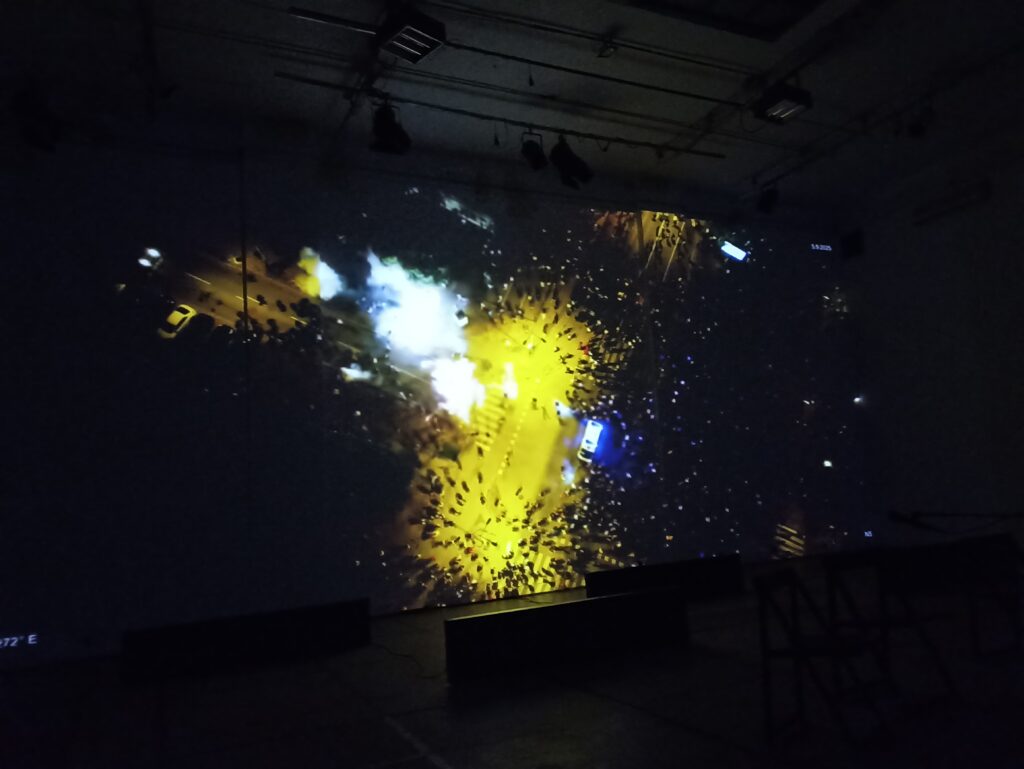
As an online platform, the work “Testimonies of Sound Attack” (Svedočanstva zvučnog napada) is based on the statements of people who were exposed to acoustic weapons during the protests on March 15, 2025, in Belgrade. Meanwhile, “Testimonies of Police Brutality” (Svedočanstva policijske brutalnosti) bears witness to the use of CN gas and the containment of protesters within the Rectorate building of the University of Novi Sad on September 5, 2025. In addition to the online platform, this second work consists of video recordings and a LED installation. Through this spatial arrangement, the statements and testimonies were “returned” to the University Campus and subsequently presented through an exhibition and discussion at the Belgrade Center for Cultural Decontamination (Centar za kulturnu dekontaminaciju[4]).
Both works were created during the past year of protests in Serbia; visually, they are interconnected and nearly identical, sharing the same artistic process or research methodology. However, stating that these works have established a link between contemporary artistic and scientific practice might not be entirely accurate—despite the fact that these collective works involved scientists, university professors, students, and artists who have even gone so far as to say these are the best works they have produced in their long careers.
Where, then, should we situate these projects, platforms, works, processes, or actions? It would be customary to say they exist on the border of these two grand disciplines, in a zone of indistinguishability. Yet, perhaps we should speak of a triple border, as the relationship to politics is also at play. The recorded events concern politics because they involve the authorities’ relationship toward human rights: “Testimonies of Sound Attack” (Svedočanstva zvučnog napada) was collected by non-governmental organizations. Furthermore, they tell us something significant about the relationship of people and citizens toward power.
Unlike the standard approach to facts, where they are often depersonalized to give the data “weight” and an air of objectivity, the method applied in these two cases is the exact opposite. Here, the primary material consists of personal, subjective statements—testimonies—from individuals who have endured violence.
Data visualization as an artistic method employed by artists Olivia Solis Villaverde and Vladan Joler is merely one element of a work that they themselves do not consider “artistic”; nor do they categorize the installation, in which they were also joined by the artist Stevan Kojić, as such. According to Vladan Joler, these works transcend the boundaries of art both in their intent—intentionally—and in their authorship. Thus, it is up to us to consider them art only if we are prepared to abandon the concept of the artwork as an “intentionally aesthetic object,” which we have no intention of doing. A mass of people and a multitude of different activities, fields of action, and roles participate in their creation, making this framework of expression also imaginary in its multiplicity.
In “Testimonies of Sound Attack” (Svedočanstva zvučnog napada), the primary participants are civil society organizations that initiated the data collection process[5]. Their role in “Testimonies of Police Brutality” (Svedočanstva policijske brutalnosti) is taken over by witnesses and friends whose roles outline a blueprint that pinpoints a crime involving not only the police but also the staff of the University of Novi Sad, led by the Rector. On the websites or platforms, all participants are listed[6] and classified by activities, each of which deserves to be treated as an intellectuality: data collection; data analysis, preparation, and processing; research; texts; programming; web design and visualization; web development; maps; video documentation; music; video editing and graphics; photography; concept and artistic installation; and production, management, and communication.
What we found particularly compelling is that the data to be visualized consisted of people’s statements—testimonies. In fact, what made it so significant was how deeply it resonated with one of the authors whom we had opportunity to talk to. For Vladan Joler, these testimonies were meaningful because they shook him. That emotional experience led to a creative process resulting in works that carry clear warnings: “This content includes distressing experiences and descriptions of injuries and may cause re-traumatization.” Essentially, the task was to visualize and respond—using the tools at hand—to something that is not just data. Unlike the standard approach to facts, where they are often depersonalized to give the data “weight” and an air of objectivity, the method applied in these two cases is the exact opposite. Here, the primary material consists of personal, subjective statements—testimonies—from individuals who have endured violence.
How does one visualize such a thing, especially when the visualizations serve as a form of interpretation? But these were merely our own questions; he—and we assume his collaborators as well—embarked on a broader undertaking of witnessing and interpreting the statements. From these, they extracted metadata used to reconstruct the crime. The strategic arrangement of information for classification purposes draws out insights that can serve various interpretive and evidentiary procedures—ones that go beyond the purely empirical and the useful in legal practice.
The Right to Research as a Human Right
The problem of situating these works within existing disciplines arises when we ask: what kind of research is this? Artistic, scientific, journalistic…? Most likely, it is none of those. Our interlocutor, the artist Vladan Joler—whose work is rooted in artistic data visualization practices—has spoken on several occasions about how scientific and investigative journalism procedures can be limiting. This is due to the multitude of strict rules, codes, and methodologies that must be followed for the results to be recognized within these established disciplines. But what, then, of artistic research?
One could argue that every artistic process—that is, the method an artist employs to create a work—has in some sense always been a form of research, whether it involves investigating materials, form, artistic or social context, content, or expression. As a term, arts-based research is a more recent coinage; it refers to the use of art and the creative process to attain new insights and expand the total body of knowledge regarding humanity, culture, society, and beyond. Another similar term, artistic research, specifies the use of ethnographic, sociological, archival, or laboratory and scientific methods in the creation of artworks, which often incorporate new media and technologies. Artistic research is said, almost self-evidently, to be interdisciplinary.
However, the concept of interdisciplinarity—so often used to explain many contemporary artistic practices—can lead us down the path of utilitarianism, suggesting that art serves a purpose outside of itself. In doing so, we need not reopen the age-old question of the autonomy of art, nor address the critiques that descend into what might be perceived as a “hatred of art.” To avoid this pitfall, in which the intellectuality of artists themselves are often situated, we aim to preserve them as interlocutors who think and intentionally create their works (whether alone or in collaboration). To ensure we do not turn the artwork into a mere object of theoretical thinking at the expense of the artist’s own intellectuality or thought, we have attempted to place these two works within the broader corpus of what is known as the “right to research.”
This involves the democratization of research and the connection that can be forged between inquiry and action. It also entails active resistance to restrictions on access to information and data through the freedom of association in research work and the free distribution of its results.
In the work of the Indian-American anthropologist Arjun Appadurai, the “right to research” argues that research should be recognized as a distinct kind of right and as a universal human capacity. Research is typically considered a specialized and technical activity belonging exclusively to experts; consequently, it is rarely viewed as a capacity with democratic potential, let alone as something that belongs to the body of human rights. According to Appadurai, the right to research—specifically the right to acquire strategic knowledge—is essential for achieving democratic citizenship. This involves the democratization of research and the connection that can be forged between inquiry and action. It also entails active resistance to restrictions on access to information and data through the freedom of association in research work and the free distribution of its results. This represents a specification of human rights that goes beyond “participation in scientific progress” and belongs to the fourth generation of human rights.
Fact-making, Visualization, Metadata
Perhaps we are liberated from the need to define the regional ontological status of these works by engaging in a dialogue with the idea of investigative aesthetics. In this concept, developed by architect Eyal Weizman[7], a clear distinction is made between art and aesthetics in favor of the latter, drawing on the original meaning of the word aesthesis, “as the capacity of matter to register and convey information about the events that shaped it.” The broader term for this concept, forensic aesthetics, represents “the way objects become speakers, the way material traces are transformed into testimonies.”
At first glance, this process seems to be in even greater discrepancy with the relationship between scientific research and art discussed previously. However, through its distinctiveness, it introduces a certain clarification or refinement of the methodology applied in the Testimonies. For Weizman, “architecture (the object) speaks.” Walls struck by shrapnel, building ruins, or the density of smoke “speak” of the type of explosive used or the direction of an attack. In this context, the researcher-artist acts as an “interpreter” who transforms this “silent speech” into an intelligible language for public forums: the courtroom, the gallery, or the media.
In the Testimonies, however, it is quite clear that it is the people who speak, not the objects. In the case of investigative aesthetics, the departure from art is achieved by shifting research from the sphere of subjective expression to the sphere of the objective investigation of political facts. Yet, the statements in the Testimonies are, in their essence, subjective expressions of individual experiences—physical, psychological, and political—which the researchers presented in their original form, without subsequent interpretation. How, then, did these subjective accounts become part of an objective investigation? How did they become objective data? Was it through their sheer volume, given that in both cases of the Testimonies, more than 3,500 statements were collected within a very short period?
Visualization produces the metadata of the testimony, as the testimonies themselves are the interpretation and the truth of what occurred.
According to Weizman, investigative aesthetics are concerned with “the production of evidence and the presentation of facts,” while simultaneously examining the very concept of evidence and the media strategies used to manipulate facts. In many other data visualization practices, the work is based on researching existing, largely publicly available data and providing a visual interpretation through which the data becomes evidence of newly produced knowledge—as seen in Vladan Joler’s earlier works, such as Calculating Empires[8]. However, what we are seeing now is the “production,” or rather generating of data from scratch—more precisely, the collection of authentic accounts and testimonies from people. What is at work here is fact-making, as opposed to the widespread journalistic practice of fact-checking.
Yet, the accounts and testimonies of individuals do not necessarily become objective facts by any of this. What grants these statements their “solidity” is the process of visualization; through it, personal trauma and the witnessing of violence are transformed into information, narrative, data, and evidence. Visualization produces the metadata of the testimony, as the testimonies themselves are the interpretation and the truth of what occurred. Through metadata, classification, and event reconstruction diagrams, the personal statements are grounded and verified. This is a matter of presentation and the complex representation of data, since the testimonies are themselves interpretations of the truth—of what actually happened.
This is particularly crucial in the case of “Testimonies of Sound Attack” (Svedočanstva zvučnog napada), as the power completely denied the use of acoustic weapons against peaceful protesters. Thus, the testimonies serve as information, narrative, data, and evidence—but could they also be considered a verdict on the side of the people in the face of state violence? That is to say, a verdict that the citizens reached themselves through this complex process of data generation and visualization (as if it were established and declared: “You are guilty, Vučić; you fired at us!”).
Thus, visualization in its broader sense—and specifically in these cases—is not merely an illustration. It represents an operational method through which people’s testimonies are not stripped of their subjectivity in favor of the rigid objectivity of facts. On the contrary, visualization grants them “solidity,” grounding their subjective, personal, and affective character. But does this return the Testimonies, as subjective expressions, to the field of art? Perhaps, but only if we believe that the artistic intention to create a work of art can be “hidden” precisely within such a process of visualization and a specific kind of mapping—cartography as an artistic medium.
Testimonies and Human Rights
There is a long history of the relationship between the testimonies of victims of violence and human rights, particularly when handled by civil society organizations for humanitarian purposes or in efforts to establish the truth of violence in courts of law. Starting with a case from recent history, which Weizman marks as a practice that has since been abandoned, we find the example of the American prosecutor Robert H. Jackson; he avoided calling Holocaust survivors to testify at the Nuremberg Trials, viewing them as unreliable and prone to hysteria. However, since the 1960s, within the context of human rights, testimonies have come to be regarded not only as sources of information but as values that are significant in their own right. Furthermore, within the human rights framework, the encounter with witnesses represented a manifestation of compassion that pitted individual voices against the arbitrariness of authoritarian states.
Weizman reminds us that this “era of the witness” reshaped our sensitivity toward the testimonies of victims, but also contributed to the depoliticization of collective situations, thereby hindering political change. For him, the “forensic turn”[9] is a practice that by no means rejects testimonies; rather, it seeks to support investigative trajectories in the work on political and human rights and to open the field of investigation toward the materiality of politics. In this case, truth and aesthetics find diverse forms of coexistence, expanding the venues where truth is presented—from courtrooms, universities, and the media, to galleries, the streets, and the internet.
In the case of the “Testimonies of Sound Attack” (Svedočanstva zvučnog napada), the process employed did not merely seek to establish truth-claims, nor was it solely a critique of the government’s monopoly over the mechanisms of truth-determination. Rather, it represents the only existing evidence—or perhaps even a civic verdict—proving that the acoustic weapon attack actually occurred. In other words, while the authorities completely denied their violent act, the people’s testimonies made it possible for that act to be brought to light and rendered real and factual.
And beyond the civic and public realms, this case reached its epilog in court. With the support of civil society organizations, a group of witnesses to the sound attack filed a lawsuit with the European Court of Human Rights, meaning that their statements—their testimonies—became indispensable data for establishing the truth within judicial institutions. What is particularly interesting is that, based on 47 lawsuits, the European Court of Human Rights issued an interim measure regarding the possible use of acoustic weapons at the protest in Belgrade, directing the authorities to prevent any use of acoustic devices for the control of gathered citizens[10]. However, that measure did not include the court’s opinion or determination as to whether the sound attack had actually occurred or not.
The reactions of the governing institutions—both Serbian and European—are conditioned, above all, by the war. The European Commission reiterated its demand that the Serbian authorities conduct a credible investigation into the use of the sound cannon, warning Serbia that cooperation with Russia, which is waging war in Ukraine, is undesirable[11]. In other words, by demanding a credible investigation, this European institution—unlike its Serbian counterparts—does not believe such an investigation is possible in cooperation with the institutions of the aggressor, Russia. Based on its own findings, the Serbian government repeated its categorical conclusion that acoustic weapons were not used during the protest.
In the eyes, the sensory apparatus, and the subjective opinion of the witnesses, the government’s categorical conclusion can only be a categorical untruth; that is, a lie. Both parts of the Testimonies create a departure and distance themselves from this lie, because the existence of this attack was established by the people themselves—through their testimonies, their visualization, and their unique representation. In other words, they have demonstrated that the truth about violence is a truth that can truly exist only on the side of the people.
References:
[1] Krizni školski semafor, Union of High School Students of Serbia: https://www.srednjoskolci.org.rs/krizni-semafor/
[2] Registar pravnog nasilja i zloupotrebe institucija, Free University: https://suuns.info/registar/
[3] Baza nasilja “Za dan posle”, IT Blockade and Academic Plenum: https://www.stopbrutalnosti.com/
[4] “Svedočanstva nasilja – razgovor i izložba” (“Testimonies of Violence – Discussion and Exhibition”): https://www.czkd.org/2025/12/svedocanstva-nasilja-razgovor-i-izlozba/
[5] The following non-governmental organizations participated in collecting testimonies from victims of the sound cannon: the Belgrade Centre for Human Rights, CRTA, FemPlatz, Civic Initiatives, A11 – Initiative for Economic and Social Rights, and the Lawyers’ Committee for Human Rights (YUCOM), while the SHARE Foundation, together with many individuals, worked on shaping “Testimonies of Sound Attack.” In the case of testimonies of violence at the University of Novi Sad, the statements were collected by the Free University (Slobodni univerzitet).
[6] In both cases of the Testimonies, the names of all the participants in these collective works are listed in the credits at the end of their respective websites.
[7] Eyal Weizman is an architect and the author of the book Investigative Aesthetics: Conflicts and Commons in the Politics of Truth (co-authored with Matthew Fuller), and the founder of the research agency Forensic Architecture at Goldsmiths, University of London: https://forensic-architecture.org/
[8] Calculating Empires is a work by Kate Crawford and Vladan Joler, which won the Silver Lion at the Venice Architecture Biennale in 2025: https://calculatingempires.net/
[9] From an interview with Eyal Weizman conducted by Yve-Alain Bois and Hal Foster, published in the journal October, 156 (2016): https://research.gold.ac.uk/id/eprint/20055/1/octo_a_00254.pdf
[10] https://www.slobodnaevropa.org/a/evropski-sud-za-ljudska-prava-beograd-zvucni-top/33401152.html
[11] The European Commission issued a new request following information that the Serbian authorities, together with the Russian FSB intelligence service, recently tested the effects of a sound cannon on dogs—all for the purpose of a purported investigation into the protesters’ claims of being attacked with acoustic weapons: https://www.politico.eu/article/serbia-vladimir-putin-documents-intelligence-lrad/
Photos: Bulletin Tenant/GKP