Journalism That Refuses to Settle, People Who Don’t Give Up: On a Study Visit to Italy
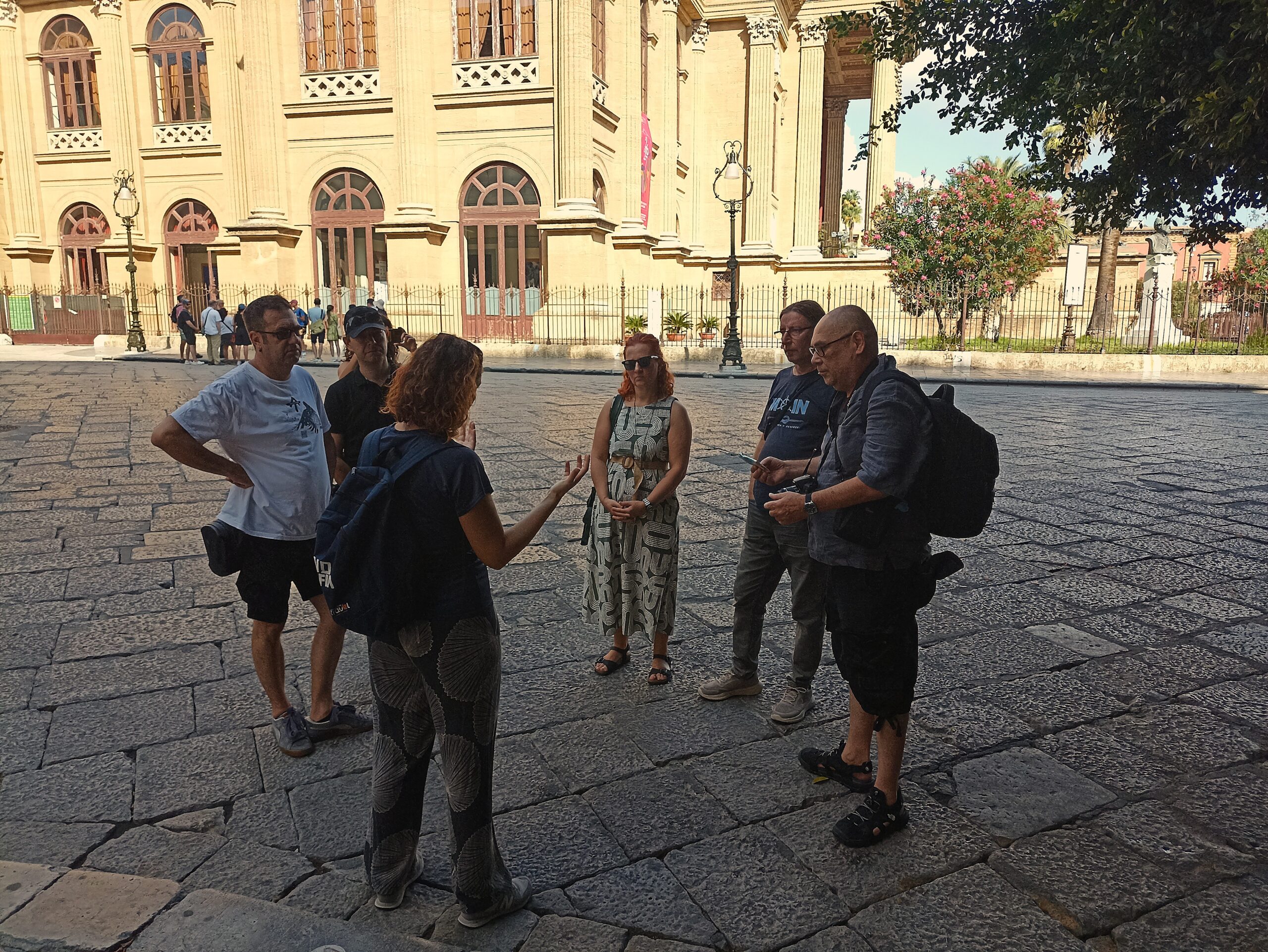
What kind of journalism we practice, and what approach we take to the problems we report on, was one of the central questions we sought answers to during our seven-day stay in Italy. It was an opportunity for active discussion and an exchange of ideas and practices around constructive and solutions journalism, as cultivated by the network of Italian journalists within the collective Italia che Cambia, together with colleagues from Serbia, journalists from local community media whose work can be summed up as – journalism in a conflictual environment. Our goal was to improve our own practices of reporting on local initiatives of people who organize to change and improve the environments in which they live and work through social, political and ecological actions. What does journalism written from the community, about the community, look like when it takes a sensitized approach that is not affirmative per se, yet not exclusively critical either? That is what we tried to reflect on during the “Study Visit and Practical Workshops” within the Erasmus+ project Change Comes from Community Media, jointly led by the Group for Conceptual Politics (GCP) from Serbia and Italia che Cambia (ICC) from Italy.
First stop: Venice of cooperatives
Six of us travelled from Serbia – journalists from five community media outlets: Storyteller from Maglić, INmedija from Inđija, Razglas.news, Autonomija, the portal of NDNV, and Bilten Stanar, the newsletter of GCP from Novi Sad. In the spirit of the project, and following the principles of “green” ecological travel, we reached Venice from Serbia by night bus. Our very first encounter with engaged citizens in this city opened up new perspectives, entirely different from Venice as a city of tourism. Thanks to our meeting with Massimo Renno and Patrizia Belletti from La Cooperativa il Filò, we gained a picture of the initiatives of people who advocate the principles of a solidarity economy in this city. The cooperative is part of the network AERES – Venezia per l’AltrA Economia, which has existed since 2008, was founded on the initiative of the City of Venice, and today brings together ethically oriented businesses, cooperatives, foundations and informal groups working in many fields: from organic production to ethical banking.
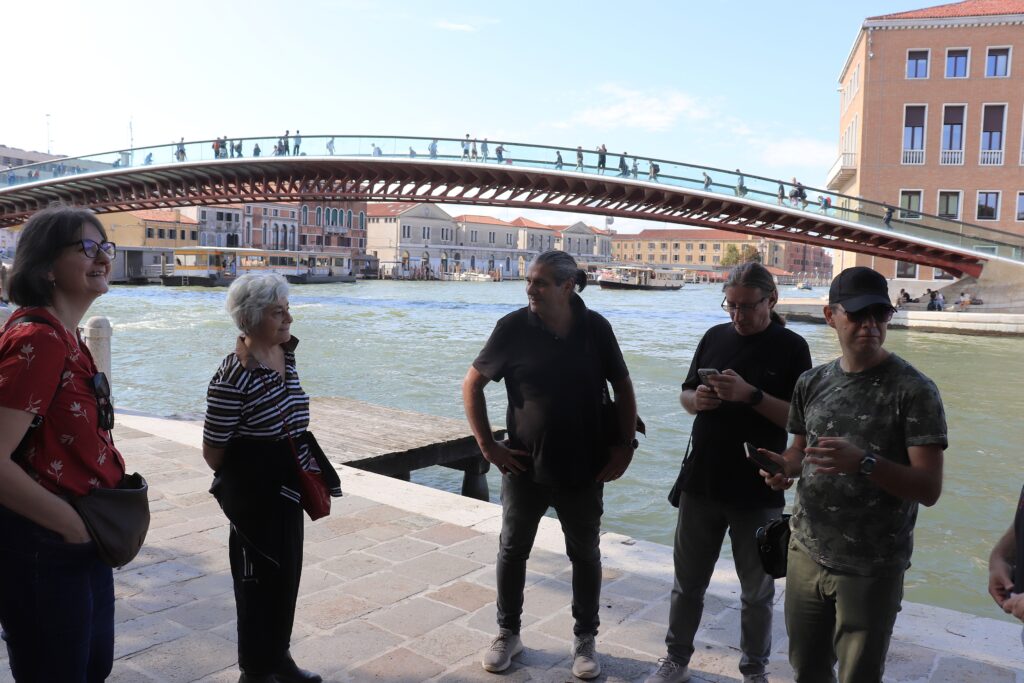
La Cooperativa il Filò is an ethical cooperative that has been operating since 1989, combining a project of social inclusion and employment with crafts and international partnerships based on fair-trade principles. After a shared tour of historic Venice that resembled urban drifting more than a tourist sightseeing walk, we had the chance to visit one of their fair-trade shops, filled with products made in ways different from the usual, commercial ones. Buying creative products in this boutique also means changing one’s relationship to consumerism, because behind each of them stands what our hosts called spaces of possibility, resistance and solidarity economies. Instead of presenting Venice as a mere souvenir and its inhabitants as part of the scenery, Massimo and Patrizia showed us the multidimensionality of the city through their effort to establish an urban civic constellation of communities that communicate with one another through ethical, solidarity and social networks, opening up new perspectives, possibilities and imaginaries. Our own perspectives began to shift with a further insight: that cooperatives are a very important and highly developed part of people’s lives and work in Italy, with a long history but also with present-day, new forms of this way of organizing.
Second stop: a Sicily that is changing
The next morning, we set off by train across the entire length of Italy, from almost its northernmost to almost its southernmost point – from Venice to the island of Sicily and the city of Palermo. This long, fifteen-hour journey had two breaks: a change at Naples from a high-speed train, which turned out to be capable of running late too, onto an intercity, which gave us both a rest and a unique experience when the train was loaded onto a ferry that carried us from the mainland, from Calabria, across to Sicily. Besides being a singular experience, this attraction was at the same time the beginning of our introduction to Sicily’s social context. The bridge over the Strait of Messina is Italy’s own Skadar on the Bojana – the emblem, in Serbian folk tradition, of a great building project forever attempted and never finished. Every government has wanted to build it, but none has managed to so far. The reasons are numerous, and the first usually cited is the extremely seismic, earthquake-prone terrain, the so-called tectonic rift created by the movement of the African and Eurasian tectonic plates. The second most commonly cited reason is its financial cost, and by no means negligible is the fear of corruption and of the involvement of the mafia, which has a tradition of taking part in infrastructure projects in Italy. And precisely that fact was our entry point and the initial point of our stay in Sicily.
-
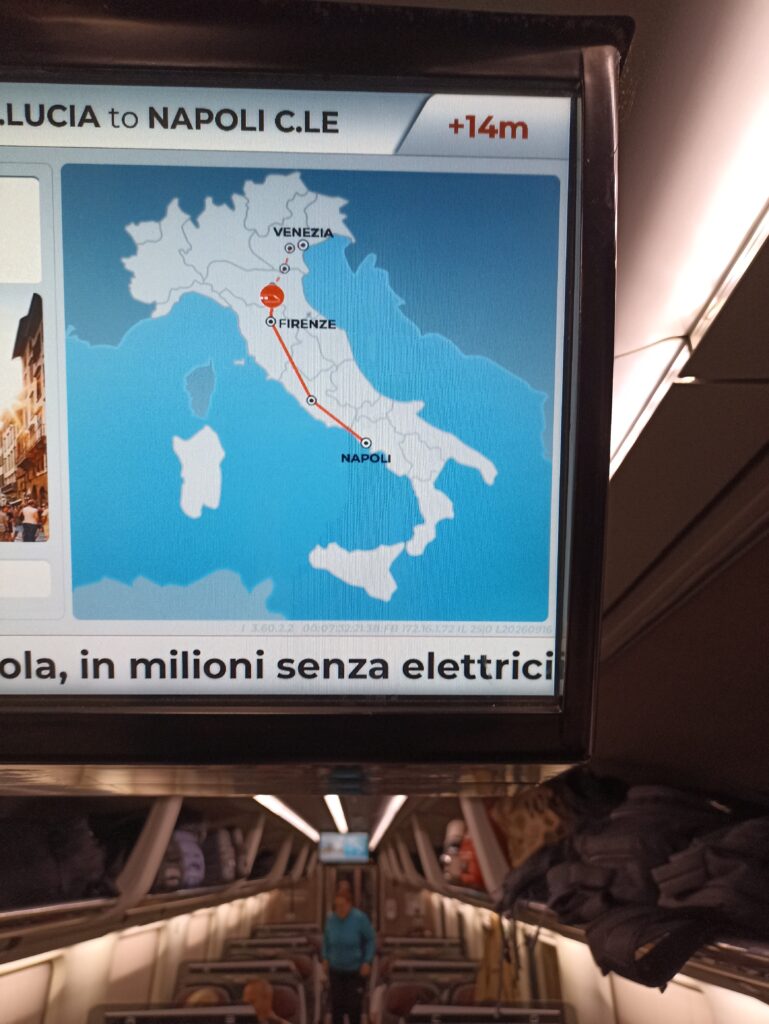
- Trip through Italy by train, over 1400km long, from Venice to Palermo; Photo: Bulletin Tenant/GCP
-
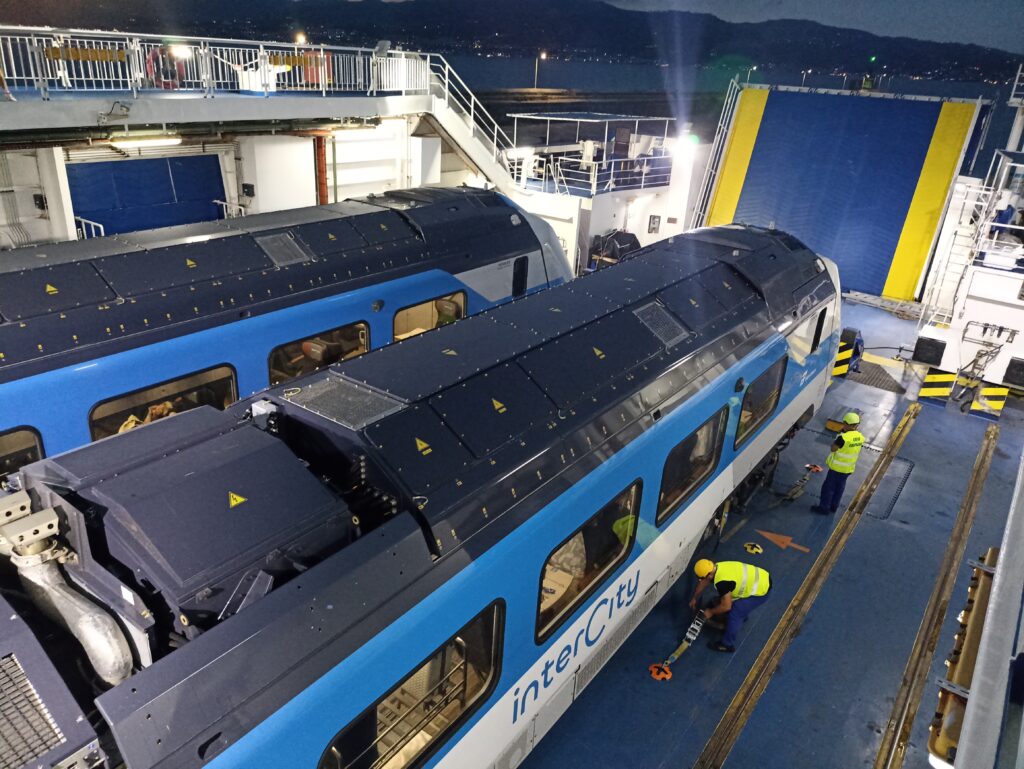
- Crossing the Strate of Messina by train on the boat; Photo: Bulletin Tenant/GCP
The lack of infrastructure is one of the things that make Sicily the “global south” not only of Italy but of the European Union, and that keep almost five million inhabitants of this island on the edge of poverty. That is why leaving Sicily in search of greater economic opportunity has long been common practice. Elisa Cutuli, editor of Italia che Cambia Sicilia, spoke to us about this through her own personal experience at the first workshop we held. Through a deeply personal story, she managed to introduce us both to the Sicilian social context and to the practices of this network of journalists. Like a great many Sicilians, Elisa left Sicily at one point, then came back, and today lives and works in Catania. That return opened up a completely different perspective on the environment in which she grew up – on the people, their initiatives, the stories she had barely noticed earlier, while she was part of that world. It is from this angle that her practice is best understood: she documents the experiences and practices of people in Sicily who find new possibilities and ways to stay, live and work on the island, as well as the inventions by which they achieve it. As she explained, it is also a way of showing that opportunities exist where stereotypes claim there is no work.
They propose financing the creation of jobs based on the real needs of the local community – that is, creating jobs that people truly want and for which there is a genuine need.
As an illustration of such an initiative, she presented a network she had reported on – Patto per Restare (Pact to Stay), launched by some sixty Sicilian organizations with the aim of building the conditions for staying on the island, and fighting depopulation and the departure of young people. This year, the network submitted to the Sicilian Regional Assembly a bill titled “Sicilia Zero Disoccupazione” (Sicily Zero Unemployment) – a document that, instead of a petition, offers a concrete operational model inspired by the French project Territoires Zéro Chômeur de longue durée (Zero Long-Term Unemployment Territories). The starting idea is simple: Sicily does not lack people able to work, but channels that would connect them with the needs of their own territory. They propose financing the creation of jobs based on the real needs of the local community – that is, creating jobs that people truly want and for which there is a genuine need.
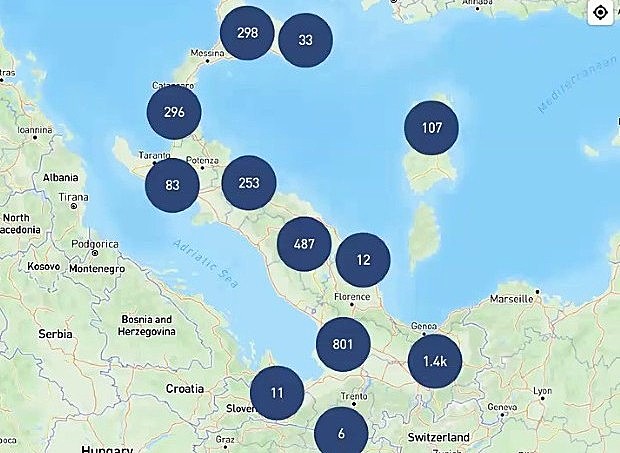
This is only one of more than 4,000 citizen initiatives that Italia che Cambia reports on and that take their place on its inverted map of Italy, where the south and Sicily are at the top and the north is at the bottom. By flipping the geographic representation, they wanted to change the usual perception of reality and symbolically free the south of Italy from imposed narratives of perpetual crisis and inferiority. Our stay and our getting to know the context proved that this gesture has its effect.
A journey within a journey: the Anti-Mafia Movement 2.0
We wanted to see what it looks like when fear and deeply rooted apathy are transformed into organized resistance from below.
Besides working and exchanging with the journalists of Italia che Cambia, our goal was to get to know some of the initiatives found on the map and in the network of this organization. For someone coming from outside, the existence of the mafia in Italy, and of Cosa Nostra in particular, often seems today like a culturalized past, mythologized through films and safely detached from present-day reality. Yet our motivation to learn about the work of the Addiopizzo movement came precisely from the knowledge that the mafia has not disappeared but merely changed its methods, just as the forms of pressure on society are changing in Serbia too. We wanted to see what it looks like when fear and deeply rooted apathy are transformed into organized resistance from below. In a society like ours, where civil society, citizens, activists and local entrepreneurs are exposed to institutional blackmail and the violence of the system, the example of AddioPizzo stands as a great inspiration.
Active for 22 years now, this network is part of the anti-mafia movement 2.0, which followed the institutional struggle against the Sicilian mafia in the early 1990s. What this network has shown is that the law of silence (omertà) and the apparent powerlessness in the face of the mafia are broken down by mutual solidarity. We wanted to understand their model of “critical consumption” (Consumo critico) – the concept in which citizens use their money to protect businesspeople who said “no” to extortion and to paying protection money to the mafia, expressed in the slogan: “I pay those who don’t pay” (Pago chi non paga). The question arose whether this kind of economic solidarity and civic courage could be applied in our atomized and polarized context.
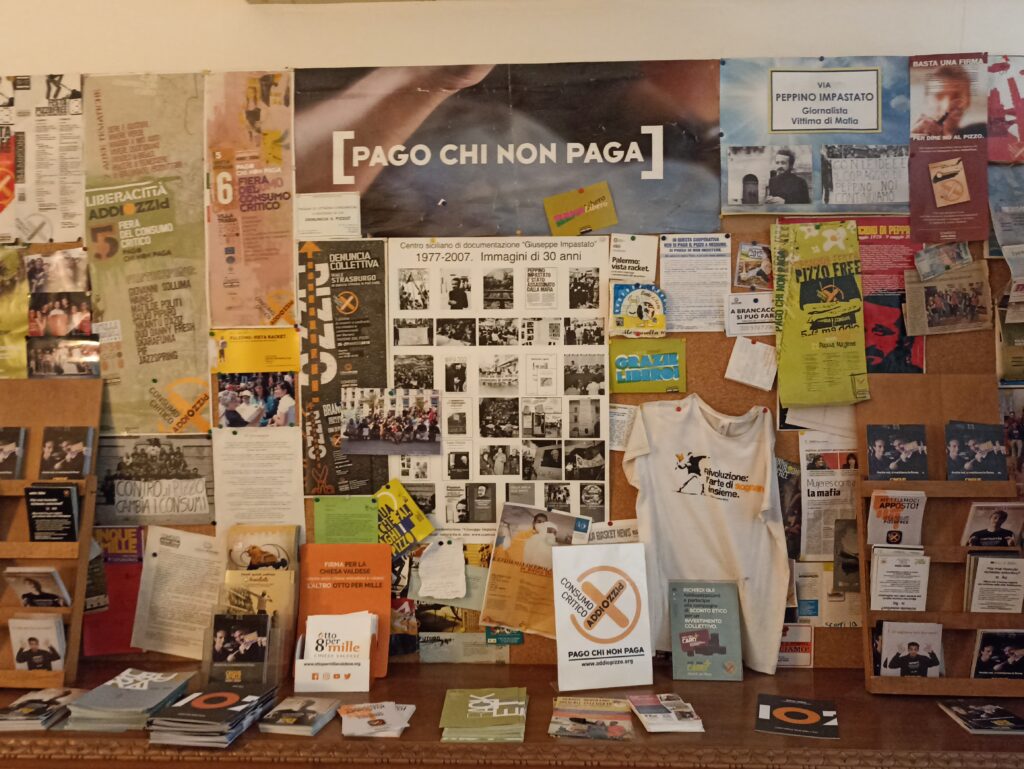
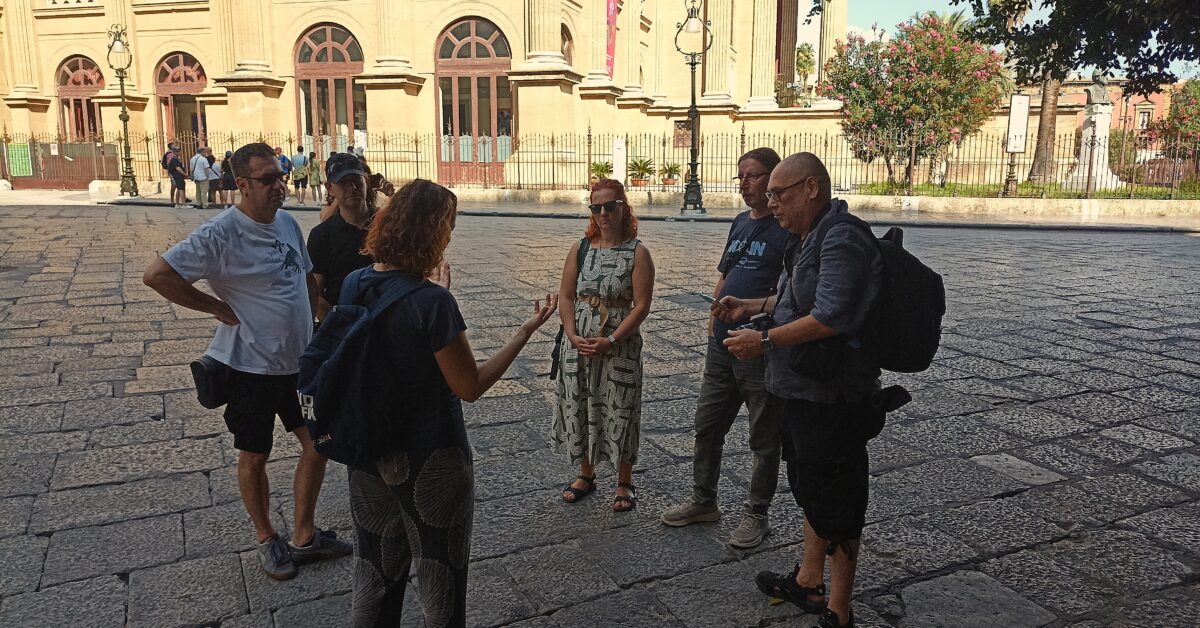
Our “journey” through this movement began with the Palermo No Mafia tour, organized for us by the social cooperative of alternative tourism AddioPizzo Travel. The three-hour walk began at the steps of the Teatro Massimo, the emblematic site of the romanticized portrayal of the mafia from The Godfather films, yet immediately broke away from that image through the real story of the mafia’s powerful, decades-long influence on the very reconstruction of the Teatro Massimo, a key place of culture and of resistance to the mafia. This guided walk through the reality of the city allowed us to get to know in detail the historical dimension of the mafia’s activity in Sicily, the layers of violence, fear and silence, but also the resistance of people that shapes the everyday life of Sicilians today. We walked the same streets along which walk the people whose stories we had yet to hear.
-
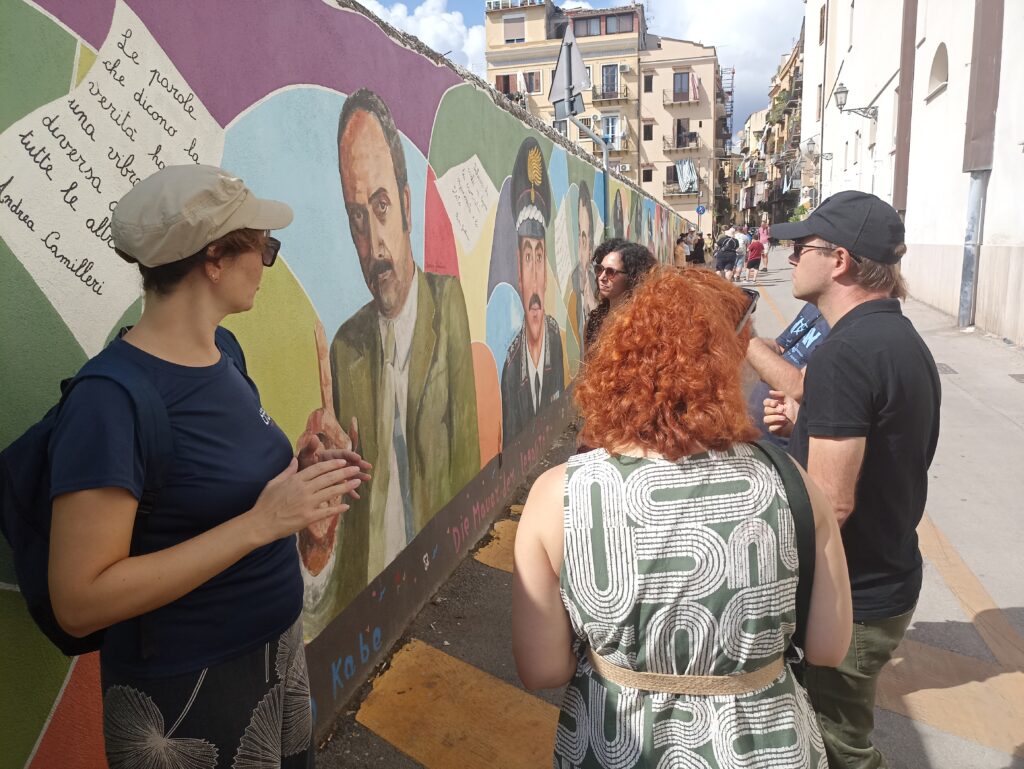
- In front of “The Wall of Legality”, art intervention and portraits of those who fought mafia and got killed by it; Photo: Bulletin Tenant/GCP
-
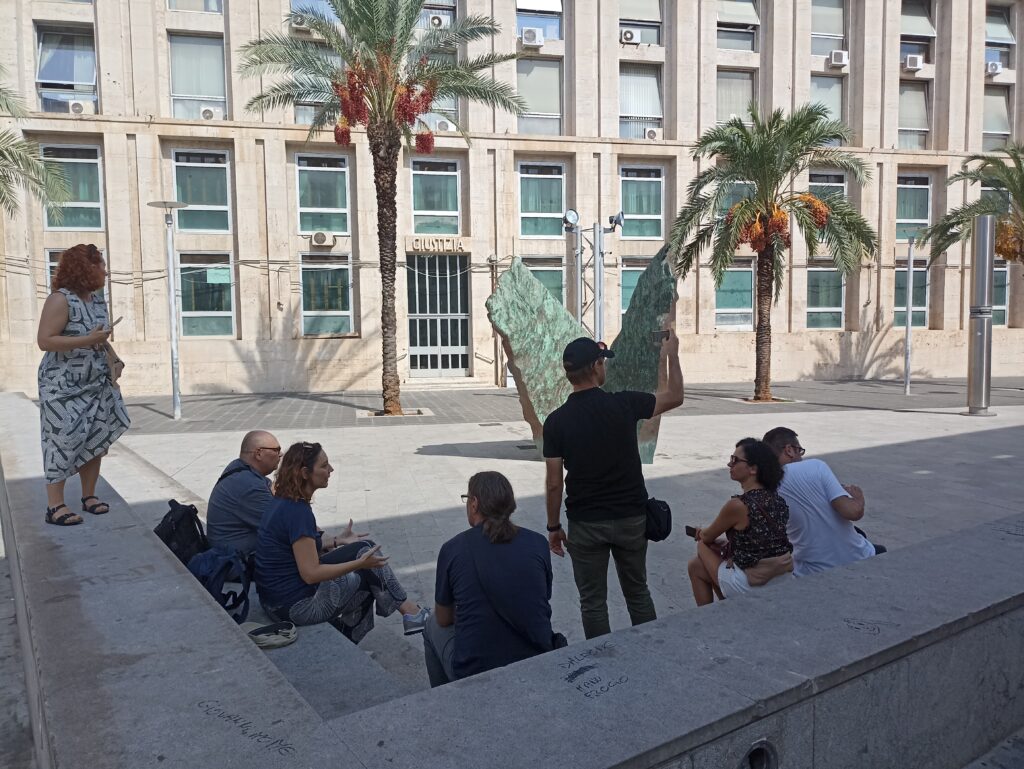
- At the Square of Memory in front of the Palazzo di Giustizia; Photo: Bulletin Tenant/GCP
And then we did hear them, at a meeting at the organization’s headquarters – the Comitato Addiopizzo, in premises that once belonged to the mafia and were then confiscated from it and handed over to civil society. We had the chance to hear the testimony of an entrepreneur, Roberto Cottone, the owner of a pizzeria, who managed to fight his way out of paying protection money to the mafia, and then we spoke with a member of the network who has long worked with people who decide to report extortion. That part of the conversation was the hardest moment of the whole trip. As Roberto spoke of the years of fear and pressure under which people live before they decide to speak out, at one point he could barely hold back his emotions, and neither could we. And the dignity he maintained is a true illustration of the slogan of the entire movement: “A whole people that pays protection money is a people without dignity.”
-
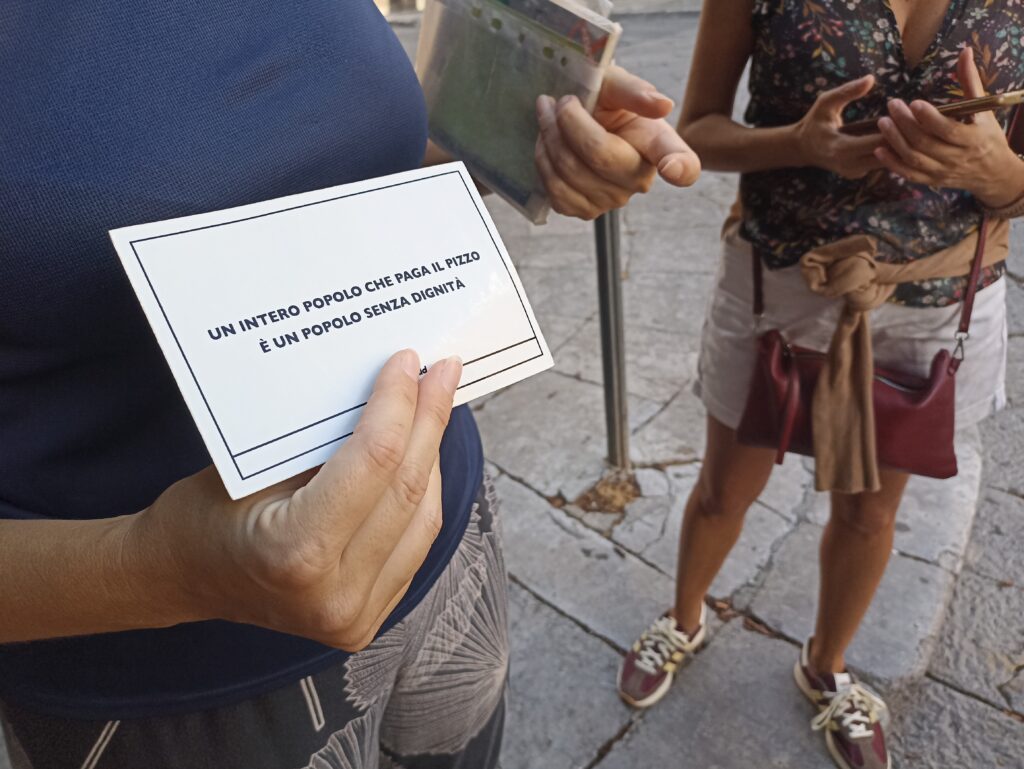
- “A whole people that pays protection money is a people without dignity” – slogan of AddioPizzo; Photo: Bulletin Tenant/GCP
-
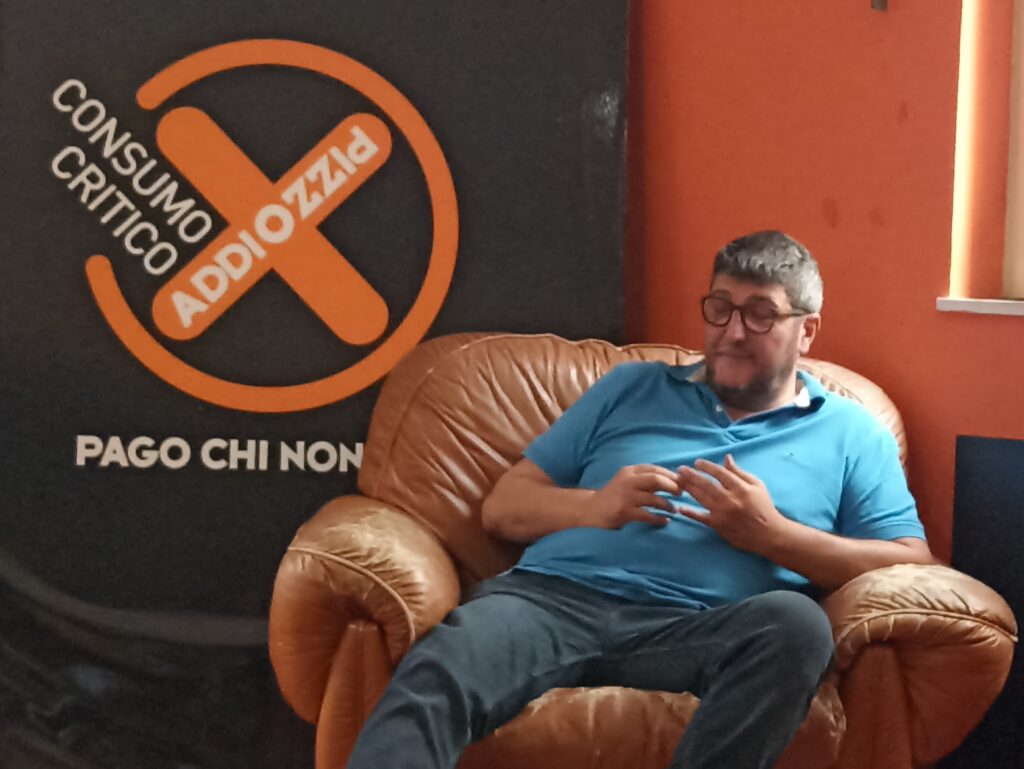
- Roberto Cottone, owner of the pizzeria who decided not to pay racket/pizzo, in Comitato AddioPizzo; Photo: Bulletin Tenant/GCP
Addiopizzo is a movement that for two decades has stood alongside those who refuse to pay the pizzo, the racket that was for centuries paid to the mafia as the price of “protection” but was in fact control over people and territory, and it helps them with legal and psychological support throughout the process, from the first decision to speak out to the courtroom. Once, around 80% of small entrepreneurs in the city paid the pizzo. Today that number is falling, but many still pay it, not necessarily out of fear, but also out of the belief that it pays off. Nevertheless, AddioPizzo today brings together 1,063 mafia-free businesses across Sicily and some 14,000 critical consumers, which significantly affects the social and economic aspects of people’s lives in Sicily.
And our journey within a journey did not end there. The following day we moved out of Palermo to Capaci, a small place in a rural area that became known for the assassination of Judge Giovanni Falcone in 1992. In a former railway station, MUST23 was established – an interactive museum with immersive rooms, a VR experience and a photographic exhibition, dedicated to the murder of Judges Falcone and Borsellino by the mafia. Our guide Nico led us through the experience and explained the authors’ idea: that every visitor first only hears, and only then sees, what the residents of Capaci experienced on 23 May 1992. It was the powerful, deafening sound of an explosion on the motorway, and only then the arrival at the place where the murder happened. Thanks to the VR experience, we could find ourselves at the site of the killing, right next to the blast crater, and in this way live through the experience of one of the greatest national tragedies in Italy. It allowed us to grasp the magnitude and weight of the fight against the mafia, as a living memory and then as an everyday resistance of people that is still present.
-
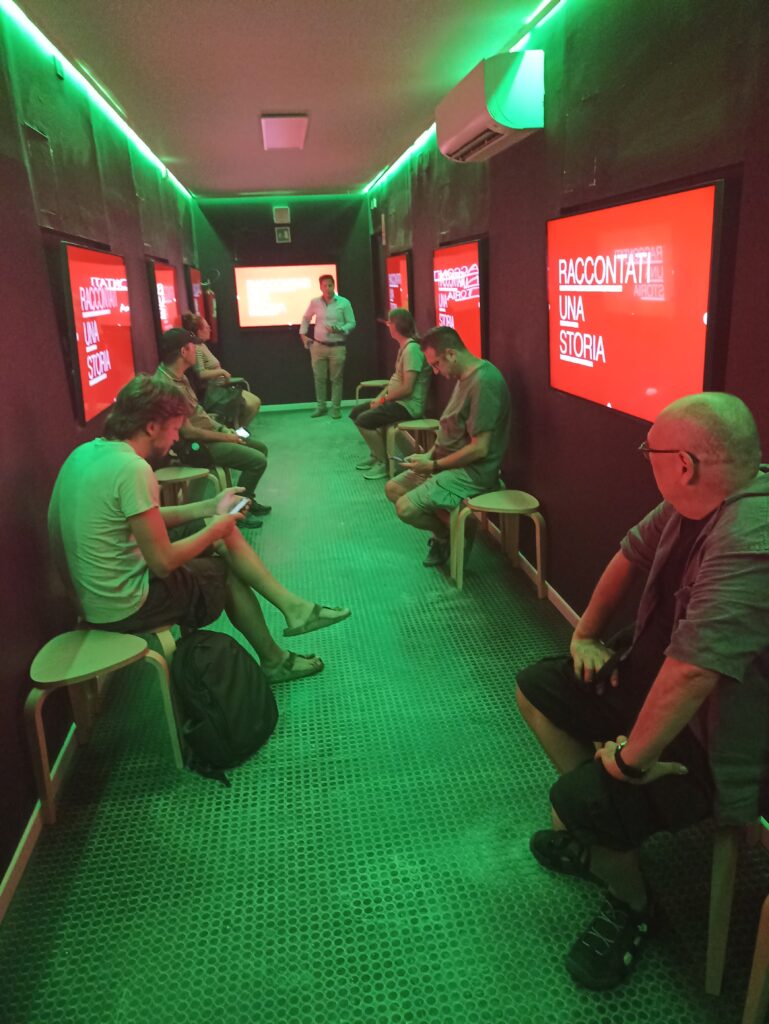
- Museum MUST23 in Capaci dedicated to the memory on murder of the judge Giovanni Falcone; Photo: Bulletin Tenant/GCP
-
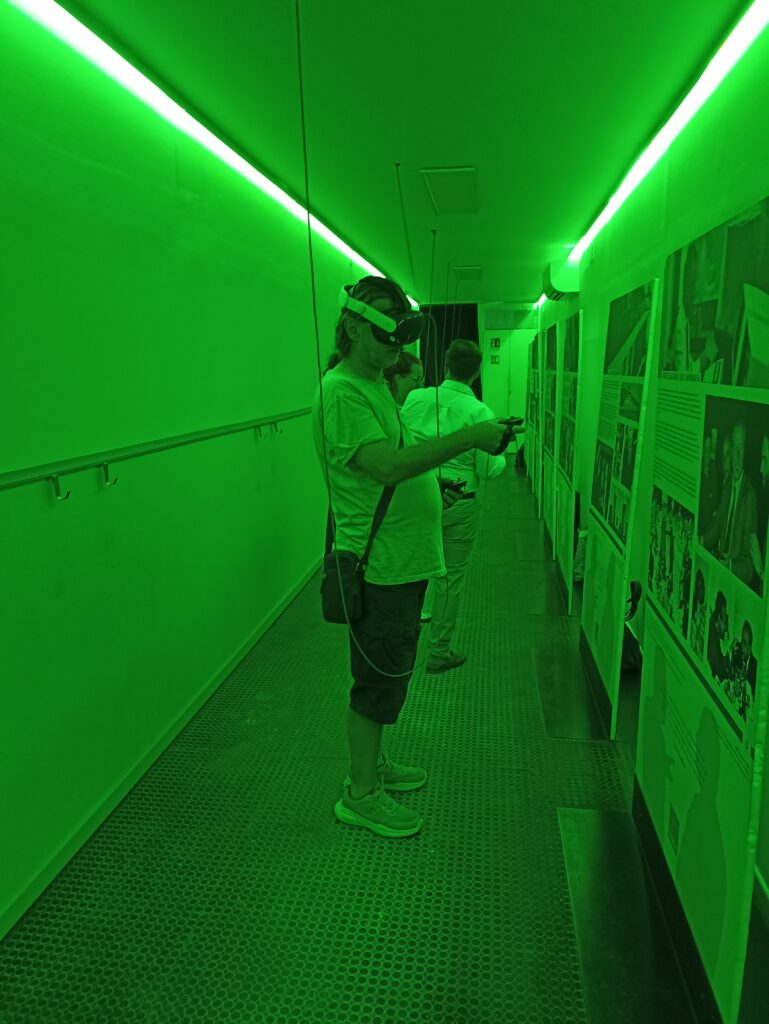
- Muzej MUST23 u Kapačiju posvećen ubistvu sudije Đovanija Falkonea, imerzivno i interaktivo VR iskustvo; Foto: Bilten Stanar/GKP
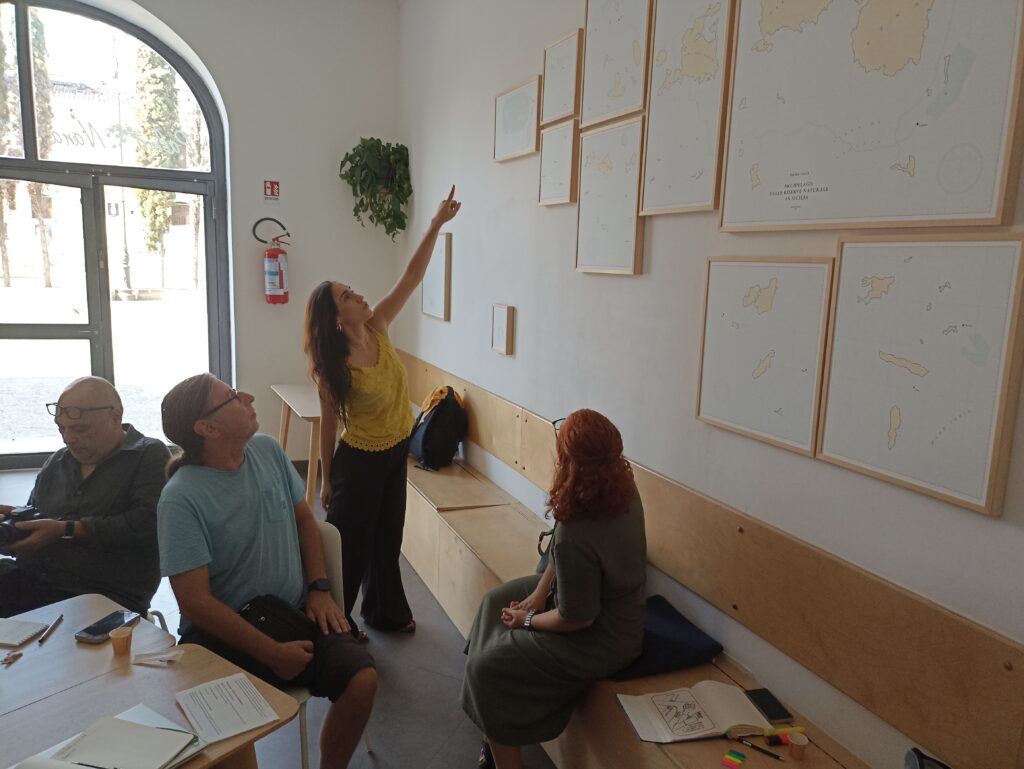
The link between the anti-mafia movement and ecology in Sicily we learned about thanks to the social cooperative Palma Nana, where we held our workshops and listened to accounts of their work. On the wall of their office, we were greeted by a large map of Sicily’s nature reserves, a visual reminder of 1983, the year this cooperative emerged from the direct, civic defence of those natural assets. Today their work rests on the inseparable principles of ecological and social justice, with a special focus on educating children and young people about civic awareness and the protection of the environment. As an active member of the Addiopizzo network, Palma Nana brings an anti-mafia dimension into ecological activism, because in Sicily organized crime has for decades been deeply entangled in illegal business and construction malpractice that directly threaten the environment. Through the example of Palma Nana, we saw how it is possible to connect the defence of nature with the defence of society against corruption and fear.
The complex relationship between journalism and activism
Through all the workshops held together with members of Italia che Cambia, with Elisa Cutuli and then with Andrea Degl’Innocenti, ICC’s editor-in-chief, a common thread ran – the relationship between local journalism and activism in two different environments, in Serbia and in Italy. These discussions and exchanges of experience raised the question of whether journalists can and should become activists who advocate for a specific cause. The point is not to abandon professional distance, but to re-examine one’s own journalistic practice and find ways, through reflection, to position it as autonomous in relation to civic initiatives, but also in relation to those in power. The position of the journalist is therefore a complex one: that of someone who, while standing for the values of democracy and organized civic engagement, should not be merely a voice against corrupt authority, but a voice that presents and explains the complex phenomena of the reality being reported on. This is precisely what Italia che Cambia does through what they call a constructive and “ecological” approach: building trust, establishing long-term contacts with people and their initiatives, and the attention they devote to every individual story they present to their audience.
Through encounters with journalists and with local initiatives that drive many local struggles and bring together a multitude of intellectual energies, this rapportage offers a signpost to what is possible: a world in which we truly can, and want to, live.
From Reportage to Rapportage
This text was not conceived as a classic travel reportage, although that too can have its value. I would rather name the form of this account rapportage, emphasizing thereby the key importance of rapport as a relationship of trust, solidarity and exchange that can be established between people. It is precisely these bonds that build an environment that is multidimensional, rich in meanings and in new directions of engagement. Through encounters with journalists and with local initiatives that drive many local struggles and bring together a multitude of intellectual energies, this rapportage offers a signpost to what is possible: a world in which we truly can, and want to, live.
—